In this illustrative scenario, a guesthouse near Kuruman keeps descaling kettles. Staff change cleaning products, guests notice cloudy glasses, and the owner considers replacing the appliances. Before ordering replacements, a useful question is whether the incoming water and existing treatment have been measured.
Understand what the deposit can mean
Water hardness is largely associated with dissolved calcium and magnesium. It can contribute to soap residue and scale, particularly when water is heated. USGS describes hardness as an equipment and housekeeping concern rather than, by itself, a drinking-water health hazard. A deposit alone cannot establish the overall safety of the supply. [hard]

Get a result you can compare
Ask for hardness in mg/L as calcium carbonate, with the sampling point identified. If a softener is installed, request paired measurements before and after it. Keep the results together so that future service visits can compare like with like.
A softener principally removes hardness minerals; it is not a substitute for microbial disinfection. Match any additional treatment to the water-quality assessment and the equipment’s stated capabilities. [cdc]
If you already own a softener, request a focused service
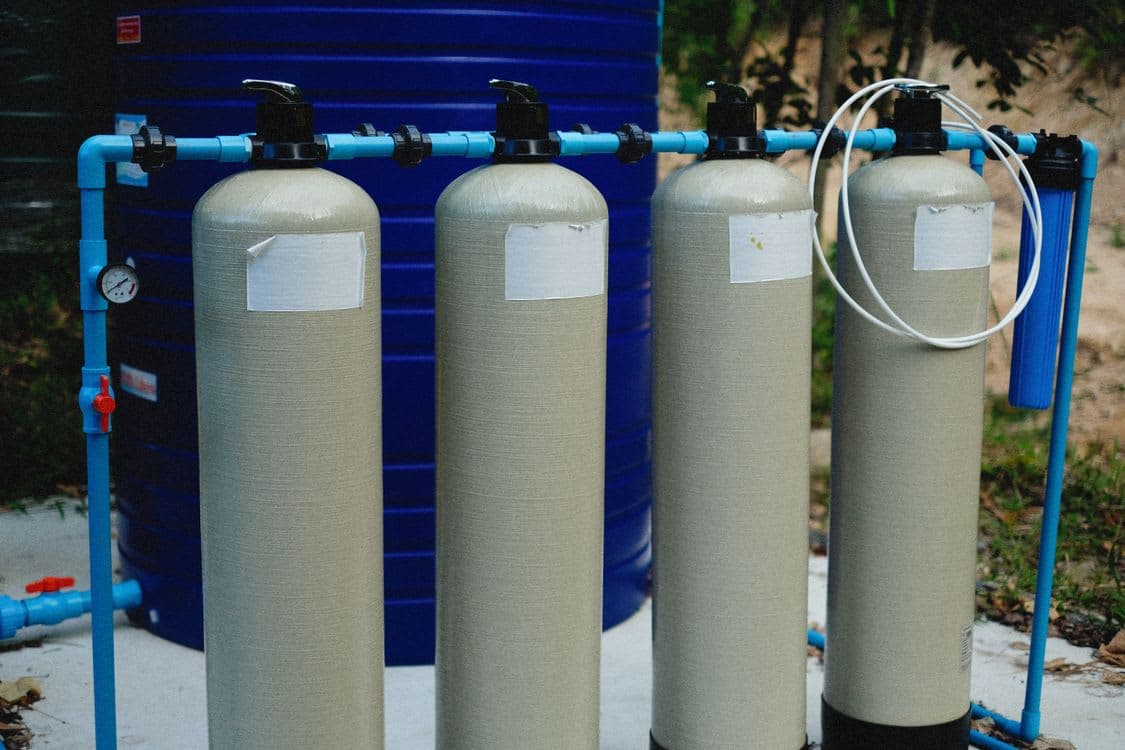
Our recommended service brief is specific: record the model, resin capacity, inlet hardness, demand, control settings and post-treatment result. Ask the technician to explain whether the system is operating as intended and whether its capacity still suits the property.
- Have the technician confirm the bypass position and regeneration settings.
- Ask for inspection of the brine arrangement and a demonstrated regeneration cycle.
- Request a before-and-after hardness result rather than a visual assurance.
- Ask which checks the owner may perform and which require a service visit.
For a mine office or guesthouse, add a simple operating log: date, occupancy or demand, salt replenishment, service work and test results. This is our suggested management approach, not a universal service interval.
Compare the full operating cost
Request separate prices for supply, installation, consumables and maintenance. Ask where regeneration wastewater will go, which appliances the design serves, and how performance will be verified. Those questions make competing quotations easier to compare than vessel size alone.
Water Nest next step: book a hardness assessment or softener service. Bring an existing laboratory report and photographs of the control head and brine tank. Then review suitable softening equipment against the agreed design brief.
References and further reading
Cover photograph: Alexey Demidov / Pexels. Illustrative stock image, not a Water Nest project. Image licence.